
17 Job Mistakes That Will Cost You Lakhs — Your Employer Is Counting on You Not Knowing These

You just got fired without notice. Or your company is making you work 12-hour days without overtime pay. Or maybe they are waving a ₹1 lakh bond in your face and threatening legal action if you leave.
And now you are scrambling. Googling your rights at 2 AM. Asking strangers on Reddit if your company can actually do this. Wondering how you ended up here.
Here is how: you did not pay attention to 17 things when you joined that job. Things your employer knew about and hoped you never would. Things that could have protected you — your salary, your career, your rights — if only someone had explained them to you before you signed.
This post is that explanation. Whether you are about to accept your first offer letter or you have been at the same company for years, these 17 terms and mistakes will determine whether your employer treats you fairly — or takes you for a ride.
Let's go through every single one.
Mistake 1: Treating the Offer Letter Like a Guarantee
You got the offer letter. The salary looks good. The role sounds exciting. You resign from your current job. You tell your family. You start imagining your first day at the new office.
And then the company ghosts you. Or delays your joining date by months. Or quietly withdraws the offer.
This is not hypothetical. Major IT companies in India have delayed joining dates by over a year after issuing offer letters — and then fired people shortly after onboarding. Freshers who turned down other opportunities were left with nothing.
Infosys just fired 400 young trainees for failing an assessment. Brutal. But not surprising. Last year, Wipro let go of 452 freshers over 'poor performance.' TCS reportedly asked employees to return to office or resign.
— Vipul Agrawal (@iamvipulagrawal) February 2025
)
Source: Business Standard — Wipro, Infosys, TechM revoked hundreds of offer letters given to freshers in 2022. IITs later blacklisted 20+ firms over last-minute offer cancellations.
Mistake 2: Not Insisting on a Written Employment Contract
Your employment is a contract. Party A (you) offers services — coding, marketing, sales, whatever your skill is. Party B (the employer) offers consideration — your salary. This exchange is supposed to be documented in a written Employment Contract, signed by both parties.
But here is the problem: most employees never see one. They get an offer letter, a joining letter, and maybe a bunch of HR policies in a PDF. They assume that is enough.
It is not enough.
New Labour Codes in India make it clear that a written Employment Contract is essential. Verbal promises — "We will increase your salary after six months," "You will get that promotion by Q3," "The variable pay always gets paid in full" — are worth nothing if they are not in writing.
What to do: Before your first day, ask for a written Employment Contract that includes your salary structure, role, notice period, and all terms discussed during the interview. Get it signed by both parties. Keep a copy. If the company resists putting things in writing, that itself is a red flag.
Mistake 3: Ignoring the NDA (and What It Actually Means)
If you work at a tech company, you probably signed a Non-Disclosure Agreement without reading it. Most people do. It seems like a formality.
It is not.
An NDA means that even if you wrote the code, the intellectual property belongs to the company. Client lists, proprietary algorithms, internal processes, product roadmaps — none of it is yours to share. Not with friends, not on LinkedIn, not with your next employer, and definitely not with competitors.
Mistake 4: Being Scared of Non-Compete Clauses
Your contract says you cannot join a competitor or start a similar business for 12 or 24 months after leaving. Sounds terrifying, right? It is supposed to.
But here is what your employer does not want you to know: post-employment non-compete clauses are void under Indian law.
Section 27 of the Indian Contract Act, 1872 is unambiguous — every agreement that restrains anyone from exercising a lawful profession, trade, or business is void to that extent. The Delhi High Court reinforced this principle — you cannot contractually prevent someone from earning a livelihood after they leave your company.
Think about it: telling a Java developer they cannot work at any other IT company is absurd. Your employer knows these clauses will not survive a courtroom challenge. They include them because they work as a scare tactic on employees who do not know their rights.
Your right: Article 19(1)(g) of the Indian Constitution guarantees your right to practice any profession. A private contract cannot override a fundamental right.
Mistake 5: Not Understanding Your Probation Period
The probation period — usually 3 to 6 months — is a mutual trial. The company evaluates whether you fit their culture and can do the job. You evaluate whether the company is worth your time.
The mistake most people make? Not understanding the terms during this period.
During probation, the notice period is often zero or very short. The company can let you go without notice, and you can leave without notice too. Your benefits might be limited. Some companies do not offer health insurance during probation.
What to do: Before joining, clarify exactly what changes during probation versus after confirmation. Ask about notice period, insurance coverage, leave policy, and PF contributions during the probation period. Get it in writing.
Mistake 6: Falling for the Employment Bond Trap
The company puts you through a training program — sometimes just basic onboarding that any new employee needs — and then slaps a bond on you. "Leave within 2 years and pay us ₹1 lakh." Or ₹3 lakh. Or ₹5 lakh.
This is designed to trap you.
Under Section 74 of the Indian Contract Act, courts only uphold bonds where the penalty is proportionate to the employer's actual, documented training costs. If the company spent ₹50,000 training you but wrote ₹5 lakh in the bond, courts will see through it and reduce it to reasonable compensation — or throw it out entirely.

Source: Law.asia — The Supreme Court in Vijaya Bank v. Prashant B. Narnaware (2025) ruled that employment bonds must be proportionate to actual training costs. Arbitrary bond amounts are not valid.
Mistake 7: Not Knowing the Difference Between CTC, Gross, and In-Hand
This is where most salary negotiations go wrong.
Your company offers you a package of ₹12 Lakhs. You mentally divide by 12 and expect ₹1 lakh per month in your bank account. Then your first salary slip arrives and you are staring at ₹72,000. What happened?
Here is what those terms actually mean:
- CTC (Cost to Company): This is the total amount the company spends on you, including things you never see — the employer's share of PF, gratuity provision, insurance premiums, and sometimes even the cost of your laptop.
- Gross Salary: Your salary before deductions like PF, professional tax, and income tax. This is the base for most calculations.
- In-Hand / Net Salary: The actual amount that lands in your bank account every month after all deductions.
The gap between CTC and in-hand can be 25-35% depending on the structure.
Amazon: 44L CTC vs 1.30L/month in hand
— Arin Verma (@ArinVerma1910) November 2023
Adobe: 45L CTC vs 1.20L/month
Google: 45L CTC vs 1.25L/month
Microsoft: 55L CTC vs 1.25L/month
Meanwhile JEE Kid who assumed 8L/month salary after seeing 1 Cr international job offer 🤡
What to do: During negotiations, always ask for the full salary breakup. Ask specifically: "What will be my monthly in-hand salary?" Do not negotiate on CTC alone — that number is designed to look bigger than what you actually receive.
Mistake 8: Accepting a High Variable Pay Component
A package of ₹20 Lakhs sounds incredible. Until you see the breakup: ₹12 Lakhs Fixed + ₹8 Lakhs Variable. That means 40% of your salary depends on performance metrics that the company defines — and can change.

Source: NITES — The IT employees union publicly condemned Infosys for cutting variable pay by 30-40%, calling it "unethical." TCS and Wipro also delayed variable payouts.
Variable pay gives the employer enormous power. They set the KPIs. They decide if you met them. They can make targets unachievable and then say, "Sorry, you only get 30% of your variable this year."
Mistake 9: Not Knowing About Statutory Bonus
Many companies hand out sweets during Diwali and call it a bonus. Some give gift vouchers. Some give nothing at all.
What they do not tell you: you may be legally entitled to a cash bonus.
Under the Payment of Bonus Act, 1965, employees within a certain salary range are entitled to a statutory bonus calculated on their basic salary. The minimum is 8.33% of your basic salary, and the maximum is 20%. This is not a gift from the company. This is your legal right.
What to do: Check if you fall within the salary threshold for statutory bonus eligibility. If you do, and your company has not been paying it, you can raise the issue with HR or file a complaint with the labour department.
Mistake 10: Letting Them Steal Your Overtime
Here is a trick companies love: they give you a fancy title. "Sales Manager." "Team Leader." "Associate Vice President." Sounds good on a business card. But the real reason for the title? Managers are often exempt from overtime pay rules.
So now you are working 60-hour weeks with a "Team Leader" title but no team, and the company says you are not entitled to overtime because you are in a "managerial" role.
Under new Labour Codes, if you work more than 48 hours a week in a non-managerial capacity, you are entitled to overtime at twice your basic salary rate. Also important: your Basic Salary must be at least 50% of your total compensation. If your company has structured your salary with a tiny basic and loaded it with "allowances," they may be violating this rule.

Source: LawChakra — The four new Labour Codes (effective November 2025) mandate that basic wages must be at least 50% of total compensation. This reshapes salary structures, PF, gratuity, and overtime calculations across India.
Mistake 11: Not Knowing Your UAN
Your Universal Account Number (UAN) is your lifelong PF identity. It follows you from job to job. Under new rules, you must generate your own UAN via the Umang App and provide it to your employer.
Why this matters: if you do not track your UAN, your PF from previous jobs can get lost in the system. Companies change, merge, or shut down. Your money should not disappear with them.
Source: Tribune India — EPFO issued notices to 144 companies for not depositing PF contributions. Employer PF arrears hit ₹26,000 crore by March 2024 — up 70% in one year.
Mistake 12: Ignoring Your PRAN and IP Number
Two more numbers most employees have never heard of:
- PRAN (Permanent Retirement Account Number): This is for your NPS (National Pension System) account. If your company offers NPS as a benefit and you switch jobs, you need your PRAN to migrate the account. Without it, your retirement savings sit in limbo.
- IP Number: This is for ESIC (Employee State Insurance Corporation), which covers medical benefits. Like PF, this migrates with you — but only if you know the number.
What to do: Before leaving any job, make sure you have your UAN, PRAN, and IP Number documented. These three numbers are your financial identity as an employee.
Mistake 13: Not Collecting Form 16
Your employer deducts TDS (Tax Deducted at Source) from your salary every month. Form 16 is the certificate that proves they actually deposited that money with the government.
Here is the nightmare scenario: the company deducts tax from your salary but does not deposit it. You file your tax return thinking everything is fine. Then the Income Tax Department comes after you — because according to their records, the tax was never paid.

Source: TaxGuru — Byju's deducted TDS from 6,000+ employees but never deposited it with the government. Employees received I-T demand notices for "unpaid" taxes. The Delhi HC later ruled that employees cannot be penalized for the employer's failure to deposit TDS (Section 205).
Mistake 14: Not Understanding Your Leave Types
Most employees know they get "some leaves." Very few understand the actual categories and what they are entitled to:
- CL (Casual Leave): For personal reasons — a family function, a day off, errands. Requires prior approval.
- SL (Sick Leave): For medical reasons. May require a doctor's certificate for extended periods.
- PL/EL (Privilege Leave / Earned Leave): This is the one most employees do not know about. You earn these leaves — typically 1 day for every 12-20 days worked. They accumulate over time. And here is the important part: you can encash unused Privilege Leave. When your balance exceeds a certain limit or when you leave the company, the company must pay you for those unused days.
What to do: Track your PL balance. Do not let HR quietly reset it at year-end if your company policy allows accumulation. Leave encashment is real money — often several weeks of salary.
Mistake 15: Not Planning for Gratuity
Gratuity is a "thank you" payment for long service — typically 5 continuous years with the same employer. It is calculated as roughly 15 days of salary for every completed year of service.
Most people either do not know it exists or do not stick around long enough to claim it. But here is an important update: under new rules, Fixed Term employees may be eligible for pro-rata gratuity even before completing 5 years.

Source: People Matters — Under the new Social Security Code, fixed-term employees can now receive pro-rata gratuity regardless of tenure. Companies with low-basic salary structures could see gratuity liabilities rise 25-50%.
What to do: If you are approaching 5 years at a company, understand what your gratuity payout will look like. Do not let an employer push you out at 4 years and 10 months to avoid the payment — it happens more often than you think.
Mistake 16: Underestimating the PIP
A Performance Improvement Plan sounds constructive. "We want to help you improve." In reality, a PIP is usually the paperwork before firing you. It creates a documented trail that justifies termination.
If you are put on a PIP — typically a 30 to 90 day period — here is what to do:
- Start looking for a new job immediately. Do not wait to see if you "pass" the PIP. The odds are stacked against you.
- Build an emergency fund. You should have 3 to 6 months of expenses saved. If you do not have this yet, start now — whether or not you are on a PIP.
- Document everything. Save emails, messages, and performance reviews. If the PIP is unfair or retaliatory, documentation is your defense.

Source: Business Today — TCS laid off thousands in 2025. Unions alleged the company used PIPs and "voluntary resignation" pressure to disguise mass terminations — avoiding statutory retrenchment obligations.
Mistake 17: Not Understanding Notice Period, Termination, and the Relieving Letter
This is where most employees lose the most money and face the most career damage. There are several connected concepts here, and confusing them can cost you.
Notice Period and Buyout
When you resign, you must serve a notice period — typically 1 to 3 months. During this time, you are still an employee and must fulfil your duties.
But what if a new company wants you to join immediately? You can pay your current employer the equivalent salary for the remaining notice period to leave early. This is called "payment in lieu of notice" or a notice period buyout.
It works both ways: if the company terminates you, they must either give you the notice period or pay you the equivalent salary upfront.
Termination vs. Layoff vs. Retrenchment
These three words mean very different things legally:
- Termination: You are being fired due to your fault — performance issues, misconduct, policy violations.
- Layoff: A temporary suspension of work because the company does not have enough work for you — common in manufacturing and seasonal industries.
- Retrenchment: A permanent removal because the company is shutting down a department, restructuring, or facing business challenges that require reducing headcount.
Why the distinction matters: layoffs and retrenchment come with specific legal protections and compensation requirements. A company cannot call a retrenchment a "termination for performance" just to avoid paying you what you are owed.
2025 Indian Layoffs:
— The India Info (@theindiainfocom) 2025
TCS: 12,000–20,000 jobs
Infosys/Wipro/Tech Mahindra: 10,000+ collectively
Amazon India: 900–1,100 jobs
These aren't "performance exits." This is mass retrenchment disguised with corporate euphemisms.
The Relieving Letter
This is the single most important document when you leave a job. The Relieving Letter formally ends your employment contract. It proves that you have been released from your duties and have no pending obligations to the company.
Without it, your next employer — especially MNCs — may not onboard you. Your PF transfer can get stuck. Your background verification can fail.
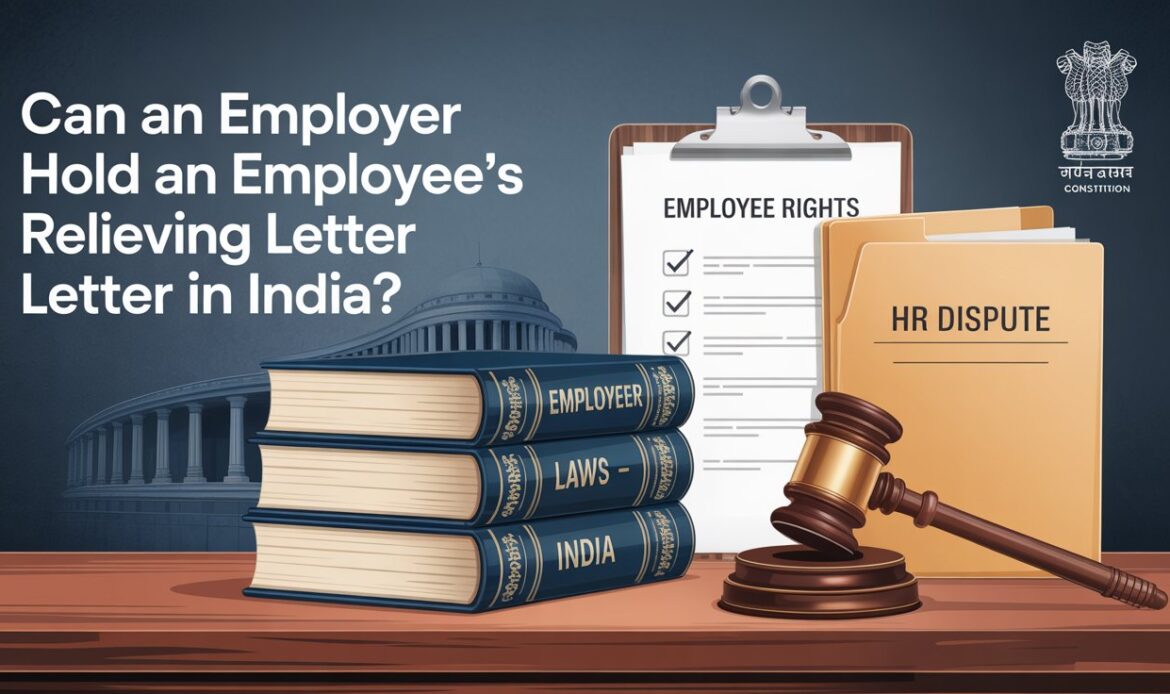
Source: Corrida Legal — Companies routinely withhold relieving letters to pressure employees into serving longer notice periods or paying inflated bond amounts. Know your rights — your employer cannot indefinitely hold this document.
The Bottom Line
None of these 17 things are obscure legal trivia. They are the basic terms of your employment — the rules that determine how much you actually earn, how you can be treated, and what protections you have when things go wrong.
Your employer knows all of this. HR knows all of this. The question is whether you know it too.
The power imbalance in employment exists because most employees are too relieved to have a job to question the terms. They sign without reading. They accept without negotiating. They trust without verifying.
Do not be that employee.
Read your contract. Ask questions. Demand things in writing. Know your UAN, PRAN, and IP Number. Collect your Form 16 every year. Understand your salary breakup. Track your leave balance. And if something feels wrong — if a bond amount seems too high, if a non-compete clause feels too restrictive, if overtime is being denied — know that the law is probably on your side.
You just have to know it exists.
Want to understand exactly what is hiding in your employment contract? Upload it to OnMyTerms.fyi — our AI reads the fine print so you do not have to. Plain English summaries, red flag detection, and instant answers about your rights. Because every contract should be on your terms.
Don't sign what you don't understand
Upload your document and get a plain English breakdown in minutes.
Analyze Your Document